
 English
  Español
  Português
  Français
  العربية
  Русский
  فارسی
فارسی  Italiano
  Türkçe
  Deutsch (Sie)
  Bahasa Indonesia
  हिन्दी
  मराठी
मराठी  తెలుగు
  Kiswahili
  Ελληνικά
  বাংলা
বাংলা  ਪੰਜਾਬੀ
  Basa Jawa
  Tiếng Việt
  한국어
한국어 In dental clinical communication, the most frustrating moment for a dentist is probably pointing at an X-ray and explaining, "There's a crack here," only to have the patient stare blankly and say, "I can't see it." The traditional mouth mirror and naked-eye observation approach is being completely transformed by wireless intraoral cameras. But with products ranging from a few hundred to tens of thousands, and specifications full of hype, how do you choose without wasting money?
Poor image quality is the most common complaint about wireless intraoral cameras. Many clinics buy so-called "HD" intraoral cameras, only to discover that when capturing a posterior root canal orifice, the image is a blurry mess; when examining proximal caries, the image is washed out with overexposed white spots, forcing the dentist to rely on guesswork. Worse still, severe image distortion can turn a straight root canal into a curved one on screen, directly misleading treatment direction. An intraoral camera with subpar image quality doesn't just fail to help — it actively disrupts diagnosis.
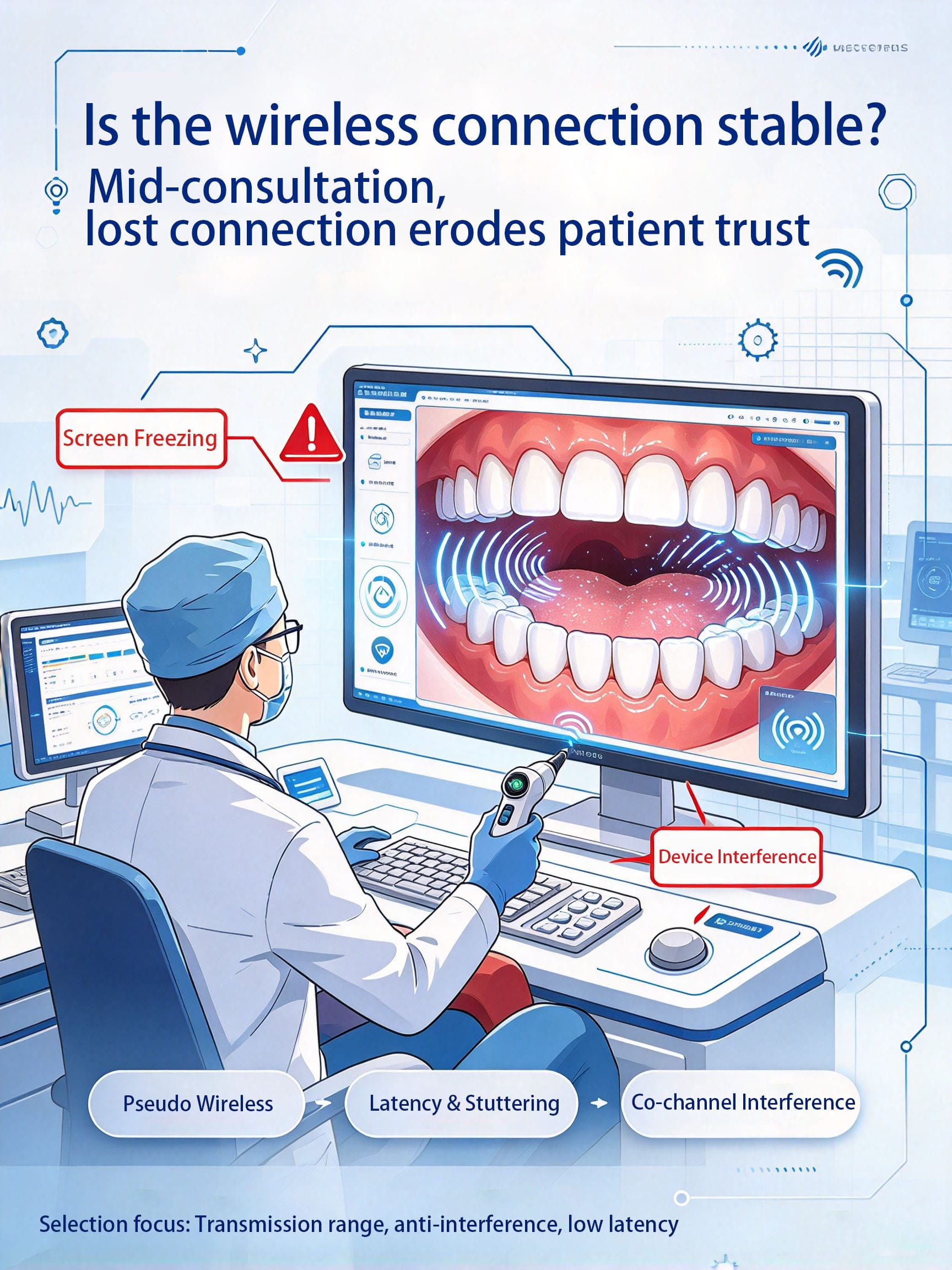
Unstable wireless connectivity is an even more frustrating flaw than image quality. A dentist is pointing at the screen explaining a treatment plan to a patient when suddenly the image freezes — or the probe has already moved to the next tooth, but the screen is still stuck on the previous frame. The trust the patient just built up collapses instantly. Not to mention when several wireless devices are running simultaneously in the clinic, signal interference causes striped flickering on the screen, forcing the dentist to awkwardly reconnect. This "pseudo-wireless" experience is worse than simply using a wired device.
A heavy handle and poor ergonomics are a hidden, daily drain on dentists. A typical intraoral camera handle plus cable often weighs over 300 grams. During consecutive patient appointments, the burden on the wrist and shoulder is significant. Especially when making fine angular adjustments within the narrow oral cavity, a heavy handle quickly tires the fingers and disrupts the rhythm of treatment.
Inadequate disinfection is a sword hanging over the clinic. Many products have handles with insufficient waterproof ratings, allowing only surface wiping. Contaminants accumulate in the crevices of the probe, creating a long-term cross-infection risk. If the probe lens is made of ordinary glass, it gets scratched in no time, and replacing it becomes another recurring expense.
These pain points actually have corresponding hard metrics that can be quantitatively screened. The wireless intraoral camera from HOM provides solutions precisely around these real clinical pain points.
In terms of image quality, the HOM wireless intraoral camera is equipped with a 1/6 CMOS image sensor, supporting 1080P high-definition resolution and 1080P ISP image processing. Posterior root canal orifices, proximal caries, and crack lines are all rendered clearly. The optical lens adopts an FOV 85° wide-angle design with distortion controlled at less than 1.0%, faithfully reproducing anatomical structures on screen. With 3P+IR infrared filtering, it effectively blocks stray light and delivers more natural color reproduction.
In terms of transmission and capture experience, the HOM wireless intraoral camera achieves zero-delay wireless connectivity — the screen displays exactly where the probe is pointing. The handle's shooting distance covers 1.2mm to 40mm, easily handling everything from deep root canal observation to full-mouth scanning with a single handle.
For grip and battery life, the handle features a lightweight design, paired with a 1000mA high-capacity battery and ≤1.2W ultra-low power consumption, meeting the demands of a full day of patient care. Smart sleep mode consumes only ≤0.7W, saving power and extending component lifespan. The handle supports full immersion disinfection, and the lens is scratch-resistant and corrosion-resistant, maintaining clear imaging even under long-term high-frequency use.
From image quality to transmission, from grip to disinfection, the HOM wireless intraoral camera transforms every clinical pain point into a verifiable hard metric — so dentists can choose with clarity and use with confidence.
Q: What is the main application of the wireless intraoral camera?
A: The wireless intraoral camera is used in dental clinics. It visually displays intraoral conditions such as cracked teeth, proximal caries and dental calculus on the screen, facilitating doctor-patient communication on conditions and assisting in oral examination and diagnosis.
Q: What key parameters should be prioritized when selecting a wireless intraoral camera?
A: Four parameters take precedence: image distortion rate, wireless transmission latency, disinfection grade, and handle weight. Excessive distortion may lead to misdiagnosis; wireless lag disrupts doctor-patient communication; disinfection performance concerns infection control in dental clinics; handle weight affects the comfort of dentists during long-hour consultations.
Q: What risks are caused by image distortion of the intraoral camera?
A: Severe distortion distorts the morphology of teeth and root canal structures. The displayed image fails to match the real intraoral condition, which may result in misjudgment of the illness and compromise treatment planning.
Q: Can the wireless intraoral camera be immersed for disinfection?
A: Not all models support immersion disinfection. Many low-cost products only allow surface wiping, with dirt easily trapped in crevices. The HOM wireless intraoral camera supports full immersion disinfection to meet infection control requirements of dental clinics.
Q: What is the significance of macro focusing range for oral examination?
A: Close-range macro shooting enables observation of root canal orifices and fine cracks; long-range shooting captures the full dental arch in one frame. A focusing range of 1.2mm–40mm allows a single device to cover all scenarios from fine lesion inspection to full-mouth scanning.
Q: Will the wireless intraoral camera suffer from frame latency or stuttering?
A: Low-end products commonly have latency, and flickering or disconnection tends to occur when multiple wireless devices are activated simultaneously. Premium models deliver real-time image synchronization, with the screen updating instantly as the probe moves.